
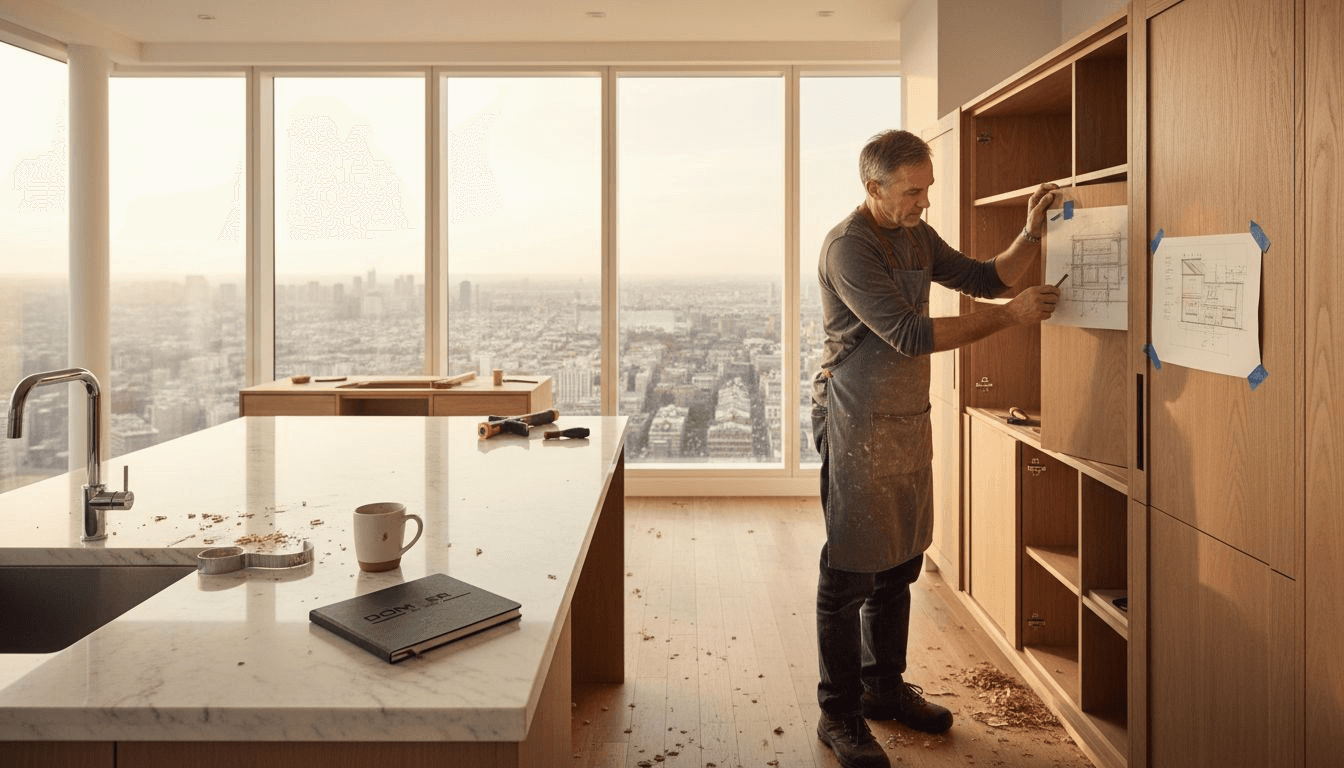
The demand for truly unique interiors is reshaping how architects and designers in Spain approach kitchen integration. Delivering the pinnacle of artisanal craftsmanship means specifying kitchens designed and built entirely from scratch, with no standardised components or compromises on material quality or spatial fit. This level of customisation transforms the kitchen into a centrepiece that reflects your clients’ lifestyle and architectural vision, offering lasting elegance and functional coherence for luxury residential projects.
Table of Contents
- What Defines A Bespoke Kitchen
- Bespoke, Semi-Bespoke, And Standard Variations
- Hallmarks Of Bespoke Kitchen Craftsmanship
- Process: From Vision To Finished Space
- Costs, Risks, And Common Pitfalls
- Alternatives To Bespoke Luxury Kitchens
Key Takeaways
| Point | Details |
|---|---|
| Bespoke Kitchens Define Artisanal Craftsmanship | A bespoke kitchen is custom-made from scratch, ensuring zero standardisation and precise integration into the client's space and lifestyle. |
| Collaborative Design Process | Effective bespoke kitchen design involves in-depth collaboration between the client and designer to reflect individual tastes and functional needs. |
| Investment in Quality and Longevity | Bespoke kitchens, while a significant investment, provide lasting value and superior craftsmanship compared to mass-produced alternatives. |
| Understanding Customisation Options | Familiarity with bespoke, semi-bespoke, and standard variations enables informed recommendations based on project constraints and client budgets. |
What Defines a Bespoke Kitchen
A bespoke kitchen is not simply a custom kitchen off a catalogue. It represents the pinnacle of artisanal craftsmanship, entirely custom-made from scratch for a single client with no standardised templates or pre-fabricated parts. Every element is conceived, designed, and built exclusively for your client's space and lifestyle.
At its core, a bespoke kitchen demands three fundamental characteristics:
- Zero standardisation: Fabricated to exact measurements with tolerances often under one millimetre, ensuring perfect integration into the architectural context
- Masterful materials: Solid hardwoods and premium natural materials sourced globally and joined using traditional woodworking techniques
- Artisan execution: Handcrafted by skilled makers who understand both the technical demands and aesthetic vision of refined design
Unlike modular or semi-custom kitchens that rely on predetermined components and sizing, a bespoke kitchen represents completely custom fabrication tailored to exact specifications. This distinction matters profoundly when you're working with constrained architectural spaces, heritage properties, or clients demanding exceptional quality.
The Collaboration Between Vision and Craft
A bespoke kitchen emerges from intimate collaboration between client and designer. Your role involves translating lifestyle rhythms, culinary practices, and aesthetic preferences into a cohesive design that functions flawlessly whilst reflecting individual taste.
This process differs significantly from specification-based design. You're not selecting from preset options; you're orchestrating every detail:
- Grain direction and wood selection for visual continuity
- Hardware placement informed by ergonomic workflows
- Storage solutions responding to actual cooking habits
- Finishes that age beautifully alongside the architecture
The kitchen transforms into a sanctuary—a space where culinary needs harmonise seamlessly with aesthetic sensibilities. Your design becomes a tangible expression of how your clients actually live.
A bespoke kitchen combines personalised elegance with functionality, standing as a reflection of both architectural integrity and the client's individual lifestyle.
Why This Matters for Your Projects
When you integrate a bespoke kitchen into a luxury residential project, you're making a conscious choice about quality, longevity, and design coherence. The structural integrity achieved through traditional joinery and solid materials ensures the kitchen remains functionally excellent and visually refined for decades.
This contrasts sharply with mass-produced alternatives that rely on standardised dimensions, veneered surfaces, and mechanical fastening. Those choices work for certain projects. For your discerning clients in Spain seeking timeless, artisanal interiors that enhance architectural projects, bespoke represents the only authentic path.
Consider how a bespoke kitchen anchors the entire spatial experience. It's not merely cabinetry; it's a carefully orchestrated dialogue between form, function, and place.
Pro tip: When presenting bespoke kitchen options to clients, lead with how the design responds to their specific workflows and the property's architectural character—not just aesthetic choices. This positions the kitchen as an integral design solution rather than an expensive upgrade.
Bespoke, Semi-Bespoke, and Standard Variations
Not every kitchen project demands a fully bespoke approach. Understanding the spectrum between complete customisation and off-the-shelf solutions helps you make informed recommendations and manage client expectations effectively.
These three categories sit on a sliding scale of customisation, cost, and timeline. Your choice depends on project constraints, client budget, and the architectural context you're working within.
Understanding the Three Approaches
Bespoke kitchens are entirely custom-fabricated from concept to installation. Every component—cabinetry, joinery, hardware placement, and finishes—is designed exclusively for that specific space and client.
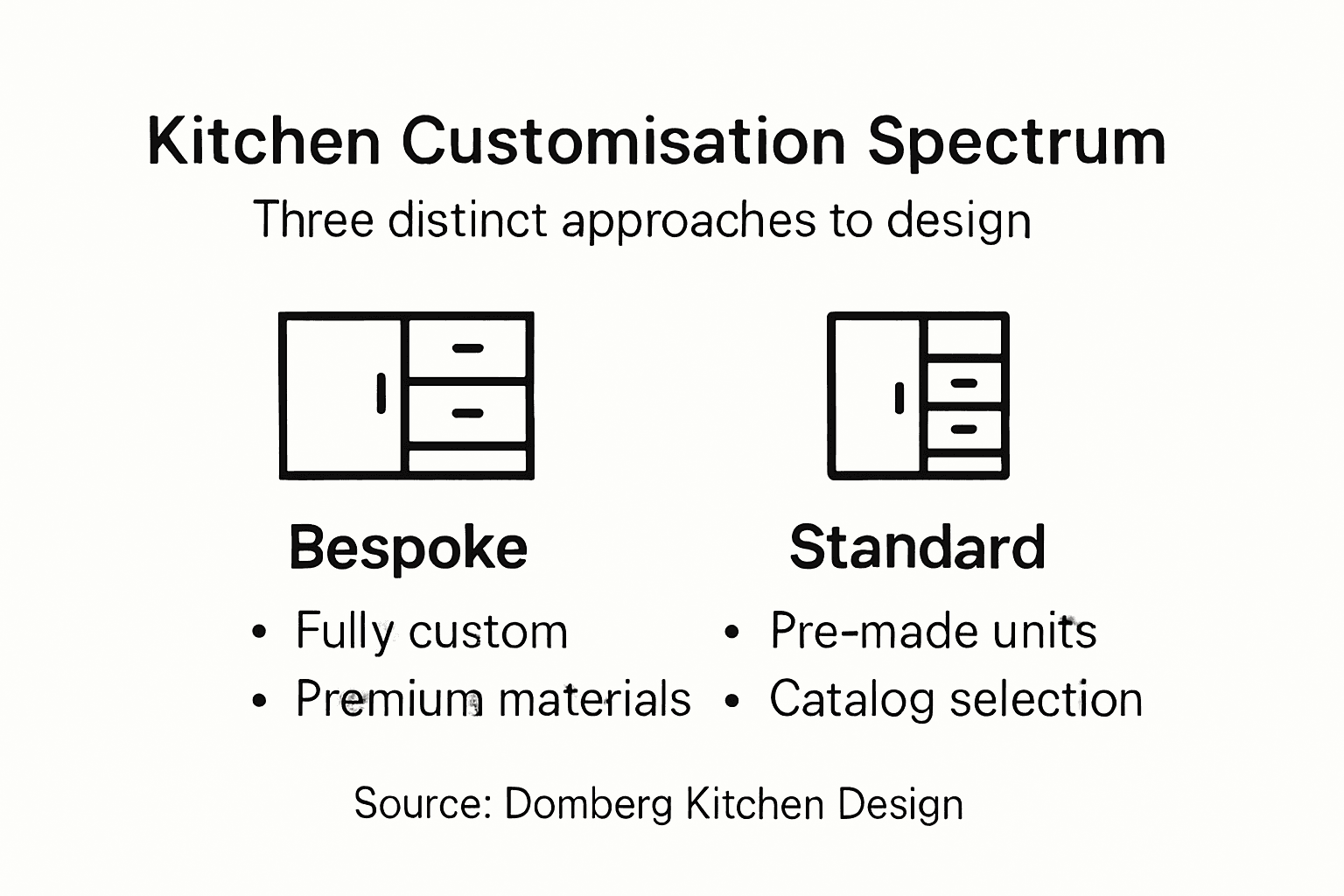
Semi-bespoke kitchens blend standardised base units with custom elements. You might use modular cabinetry as a foundation, then commission bespoke fronts, worktops, or specialised storage solutions tailored to the client's needs.
Standard kitchens rely on pre-manufactured components selected from catalogues and assembled on-site. While these offer faster delivery and lower costs, they provide minimal design flexibility.
Key differences between them:
Here's how bespoke, semi-bespoke, and standard kitchens differ in practical terms:
| Aspect | Bespoke Kitchen | Semi-Bespoke Kitchen | Standard Kitchen |
|---|---|---|---|
| Personalisation Level | Designed solely for client and space | Mix of tailored and standard elements | Catalogue-based, few options |
| Response to Constraints | Optimises tricky architecture | Selectively addresses problem areas | Rarely fits awkward spaces |
| Enduring Value | Lasts generations with proper care | 15–25 years before replacement needed | 10–15 years usability |
| Project Role | Centrepiece of interior, sets tone | Harmonises but not always dominant | Functional, not a statement |
- Timeline: Bespoke requires 16–24 weeks; semi-bespoke, 10–14 weeks; standard, 4–8 weeks
- Cost: Bespoke represents significant investment; semi-bespoke offers middle ground; standard provides budget-friendly options
- Flexibility: Bespoke adapts to any space; semi-bespoke works within certain constraints; standard requires spaces to fit the kitchen
- Longevity: Bespoke construction with solid materials lasts 30+ years; semi-bespoke, 15–25 years; standard, 10–15 years
The right choice depends not on prestige, but on whether the kitchen must integrate seamlessly into the architectural vision and serve the client's actual lifestyle.
When Semi-Bespoke Works Best
Semi-bespoke solutions shine when you face budget constraints or tight timelines without compromising design intent. You might specify high-quality modular cabinetry, then commission custom door fronts in locally sourced timber matching the project's material palette.
This hybrid approach is particularly effective for:
- Period properties requiring authentic joinery details combined with modern convenience
- Projects where the kitchen is one component of a larger renovation
- Clients valuing quality but working within realistic budgetary limits
- Spaces where architectural constraints demand selective customisation
The advantage lies in balancing craftsmanship with practicality. You're not compromising—you're strategically targeting custom investment where it creates the most visual and functional impact.
Pro tip: When presenting options to clients, frame semi-bespoke as "strategic customisation" rather than a compromise. Highlight which elements will be bespoke (usually visible joinery, door fronts, and hardware) and explain how this approach accelerates delivery whilst maintaining design coherence.
Hallmarks of Bespoke Kitchen Craftsmanship
True bespoke kitchen craftsmanship reveals itself through observable details that distinguish artisanal work from mass production. These hallmarks tell you immediately whether a kitchen was genuinely custom-designed or merely configured from a catalogue.
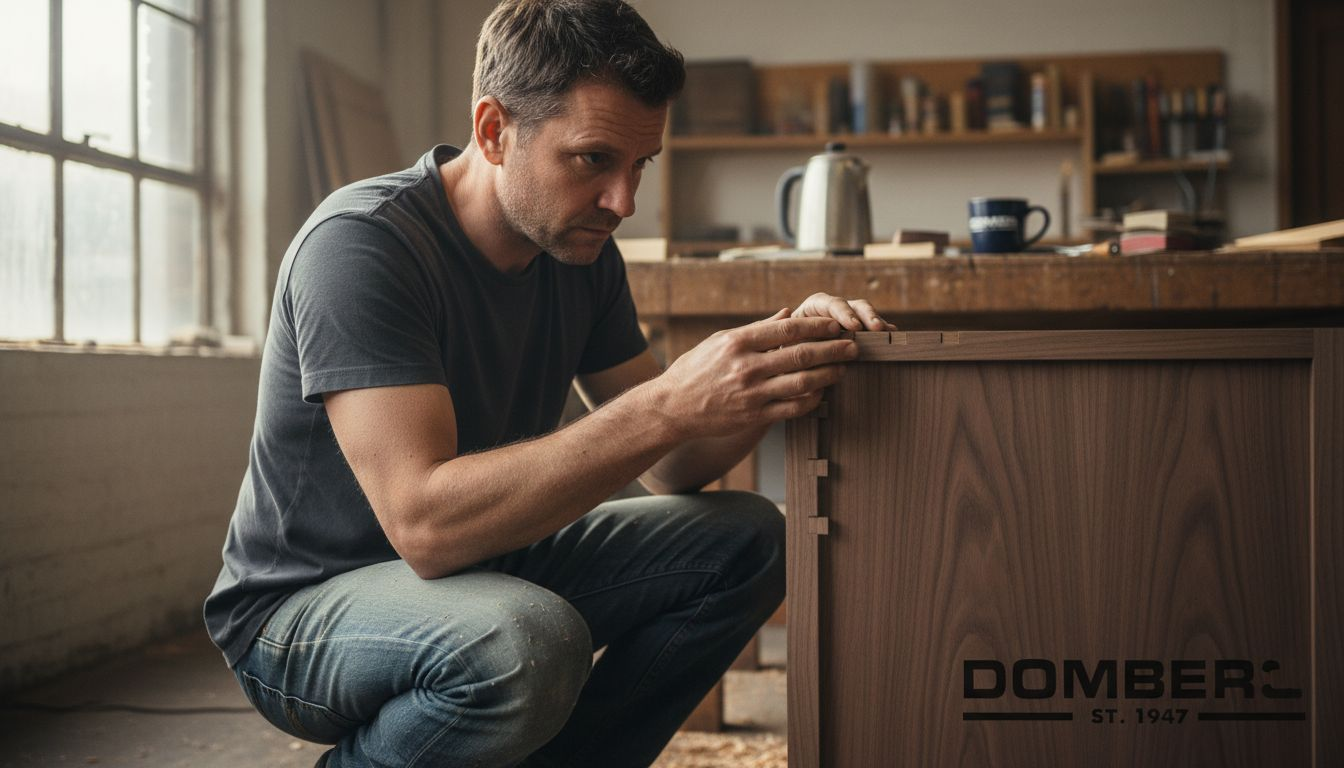
When you examine a bespoke kitchen closely, you're reading the maker's intentions. Every joint, finish, and detail reflects deliberate decision-making rather than standardised assembly.
Hand-Finished Details and Joinery
The most telling sign of bespoke work appears in hand-finished surfaces and bespoke joinery techniques. Artisans don't simply assemble pre-cut components; they respond to wood grain, timber movement, and structural demands specific to that kitchen.
Look for these indicators:
- Grain-matched door fronts where timber selection creates visual narrative across the kitchen
- Traditional joinery (mortise and tenon, dovetail) instead of pocket holes or dowels
- Hand-planed surfaces showing subtle texture rather than industrial flatness
- Seamless integration where cabinetry responds to architectural features without filler panels
Handmade kitchens emphasise hand-finished details and bespoke joinery, creating functional elegance that integrates seamlessly with architectural nuances. This approach means filler panels become unnecessary because the kitchen adapts precisely to the space.
Bespoke craftsmanship eliminates compromises between aesthetics and function by designing each element specifically for its architectural context.
Material Selection and Premium Quality
Bespoke kitchens demand premium, carefully sourced materials selected not just for appearance but for performance and longevity. Artisans understand wood movement, grain behaviour, and how different species age alongside architectural finishes.
You'll notice:
- Solid timber throughout, not veneered surfaces on visible components
- Thoughtful timber species choices matching architectural materials and regional character
- Hardware selected for durability rather than cost, often custom-finished to specification
- Finishes (oils, waxes, lacquers) applied by hand in multiple layers for depth and longevity
This investment in materials reflects a fundamental philosophy: the kitchen should endure gracefully for decades, improving with age rather than declining.
Spatial Optimisation Without Compromise
Bespoke design eliminates the friction points inherent in standard kitchens. Because the kitchen is fabricated to exact dimensions, storage solutions integrate perfectly into awkward spaces, angled ceilings, or heritage architectural features.
You gain:
- Storage that actually fits the client's possessions and workflows
- No wasted dead space or unnecessary filler panels
- Integration with existing architectural elements rather than working against them
- Solutions for constraints that would be insurmountable in modular systems
This spatial intelligence distinguishes bespoke from everything else. You're not adapting the space to the kitchen—the kitchen adapts to the space.
Pro tip: When presenting bespoke kitchens to architects and designers, lead with photographs showing grain matching, joinery details, and how the kitchen integrates with period features. These visual proofs of craftsmanship speak louder than specifications.
Process: From Vision to Finished Space
The journey from initial concept to a finished bespoke kitchen requires structured collaboration, clear communication, and expert craftsmanship. Understanding this process helps you manage client expectations and ensures alignment at every stage.
Bespoke kitchen creation isn't rushed. It demands time for discovery, design refinement, fabrication, and installation—each phase building on the previous one with meticulous attention to detail.
Stage One: Discovery and Consultation
The process begins with deep understanding of your client's needs, lifestyle, and aesthetic vision. This isn't a brief specification meeting; it's a thorough exploration of how they actually cook, entertain, and live.
During this phase, gather:
- Detailed information about cooking styles, frequency, and preferred techniques
- Storage requirements based on actual possessions and shopping habits
- Workflow preferences and how family members interact in the kitchen
- Architectural constraints, existing materials, and integration opportunities
- Aesthetic references and material preferences
Sketch the existing space comprehensively. Measure twice, document everything. The precision you invest here prevents costly revisions during fabrication.
Successful bespoke kitchens begin with architects and designers who truly understand how their clients live, not simply what they think they want.
Stage Two: Design Development and Visualisation
Translate the discovery findings into detailed design drawings and 3D visualisations. Your client needs to see the kitchen before fabrication begins—both technically and aesthetically.
This stage involves:
- 2D floor plans showing exact dimensions and spatial relationships
- 3D renderings depicting materials, finishes, and spatial flow
- Detail drawings for custom elements like joinery, hardware, and storage solutions
- Material samples allowing clients to assess colours, grain, and finishes in their actual lighting
Refinement happens here. Adjust proportions, reconsider material combinations, and solve spatial challenges before artisans begin work. This iterative design process prevents mid-fabrication surprises.
Stage Three: Fabrication and Craftsmanship
Once designs are finalised, skilled artisans begin the meticulous work of fabrication. Quality craftsmanship demands traditional joinery techniques and premium material selection, with hand-finished details creating the kitchen's character.
Fabrication typically requires 10–16 weeks depending on complexity. During this period:
- Artisans work from detailed specifications and drawings
- Progress photography documents the creation process
- Quality checks occur at critical points
- Client approvals happen before final finishing
This timeline isn't excessive—it reflects the reality of genuine handcraft and the refusal to compromise on quality.
Stage Four: Installation and Integration
The final phase involves professional installation integrating the bespoke kitchen into the architectural space. Skilled installers ensure perfect alignment, water and electrical integration, and seamless transitions with surrounding materials.
Installation typically requires 2–4 weeks. Post-installation, you'll provide client training on finishes, maintenance, and care.
The bespoke kitchen process involves these distinct professional phases:
| Stage | Key Focus | Value for Client |
|---|---|---|
| Discovery & Consultation | Uncover true needs, measure and document | Avoids future costly mistakes |
| Design Development | Create drawings and material samples | Ensures visual and technical accuracy |
| Fabrication & Craftsmanship | Skilled artisan production | Guarantees long-term durability |
| Installation & Integration | Perfect fit in architectural context | Seamless final appearance and usage |
Pro tip: Establish a project timeline showing realistic durations for each phase and communicate this transparently from the beginning. Clients who understand the timeline rarely become impatient, because they recognise the investment in quality is worth the wait.
Costs, Risks, and Common Pitfalls
Bespoke kitchens represent significant financial and temporal investment. Understanding realistic costs, potential risks, and common mistakes helps you counsel clients effectively and protect project integrity.
This section addresses the realities that separate successful bespoke projects from problematic ones.
Understanding True Costs
Bespoke kitchen costs typically range from €25,000 to €80,000 or more, depending on size, materials, complexity, and finish specifications. This investment reflects genuine handcraft, premium materials, and expert labour—not inflated pricing.
Costs break down approximately as:
- Materials: 35–45% (solid timber, hardware, finishes, specialist components)
- Labour and craftsmanship: 40–50% (artisan time, design development, fabrication expertise)
- Installation and integration: 10–15% (professional fitting, electrical, plumbing coordination)
- Design and project management: 5–10% (architectural fees, site coordination, quality oversight)
When clients balk at pricing, they're often comparing bespoke kitchens to semi-custom or standard options without understanding the fundamental differences. Educate them about longevity—a bespoke kitchen lasting 30+ years costs significantly less per year than a standard kitchen replaced every 10–12 years.
The true cost of a kitchen isn't its purchase price; it's the total cost of ownership over its lifetime, including replacement, repairs, and functional compromise.
Common Pitfalls and How to Avoid Them
Misaligned expectations cause most bespoke kitchen problems. Prevent these common issues:
Incomplete discovery phase. Rushing through initial consultations leads to designs that don't match how clients actually live. Invest time upfront exploring workflows, storage needs, and aesthetic preferences thoroughly.
Changing requirements mid-fabrication. Once artisans begin work, changes become exponentially expensive. Lock down specifications during the design phase and manage change requests through formal processes with transparent cost implications.
Ignoring architectural context. A beautiful kitchen that doesn't integrate with the property's materials, proportions, or character becomes visually jarring. Always analyse existing architectural features and material palettes before designing.
Selecting wrong materials for the environment. Kitchens in humid coastal regions or near water features demand moisture-resistant species and finishes. Material selection must respond to local climate and site conditions.
Inadequate contingency planning. Budget 10–15% contingency for unforeseen structural issues, hidden water damage, or unavoidable revisions discovered during installation.
Risk Management Strategies
Protect projects through structured processes:
- Document everything in writing—specifications, materials, timelines, costs, change order procedures
- Establish clear approval checkpoints before fabrication, during production, and pre-installation
- Schedule detailed site surveys identifying structural issues before design finalisation
- Require detailed progress photography from the maker at each fabrication stage
- Confirm final measurements on-site immediately before installation begins
- Maintain open communication between all stakeholders—designer, maker, installer, client
These practices prevent costly surprises and ensure accountability throughout the process.
Pro tip: When presenting costs to clients, frame the investment relative to how long they'll inhabit the property and how much they'll use the kitchen daily. A family cooking 5+ times weekly benefits enormously from bespoke functionality and will appreciate the investment far more than a family ordering takeaway daily.
Alternatives to Bespoke Luxury Kitchens
Not every project demands a fully bespoke kitchen. Understanding viable alternatives helps you recommend solutions matching client budgets, timelines, and project contexts without compromising design integrity.
Each alternative sits on a spectrum between complete customisation and off-the-shelf convenience, with distinct advantages and limitations.
Semi-Bespoke Kitchens: Strategic Customisation
Semi-bespoke kitchens blend modular base units with custom elements, offering a pragmatic middle ground. You specify standardised cabinetry as your foundation, then commission bespoke door fronts, worktops, or specialised storage responding to the client's specific needs.
This approach works particularly well when:
- Budget constraints prevent fully bespoke investment
- Timelines require faster delivery than pure bespoke allows
- Only certain kitchen elements need customisation
- The project is part of a larger renovation with competing priorities
Semi-bespoke typically costs 30–50% less than fully bespoke whilst maintaining design coherence. Fabrication takes 10–14 weeks rather than 16–24 weeks, making it attractive for clients balancing quality with practicality.
Semi-bespoke kitchens prove that strategic customisation often delivers more value than pursuing full bespoke when constraints are real.
High-End Modular Systems
Premium modular kitchen manufacturers offer sophisticated, well-designed systems with exceptional material quality and finishing. These aren't standard catalogue kitchens; they represent serious design investment from established luxury brands.
These systems provide:
- Extensive material and finish options
- Sophisticated spatial planning software
- Professional installation and support
- Faster delivery timelines (8–12 weeks)
- Lower costs than bespoke (€15,000–€40,000)
The trade-off involves accepting predetermined dimensions and less architectural flexibility. For rectangular spaces without unusual constraints, high-end modular systems deliver excellent results at significantly lower investment.
Period-Appropriate Reproduction Kitchens
For heritage properties and period homes, bespoke craftsmanship in traditional joinery and materials creates kitchens respecting architectural authenticity whilst providing modern functionality.
These kitchens combine:
- Historically appropriate designs and proportions
- Traditional construction techniques (mortise and tenon joinery, hand-finished details)
- Period-correct materials and finishes
- Modern appliance integration
They're bespoke in nature but specifically designed to harmonise with existing architecture rather than contrast with it. Costs are comparable to contemporary bespoke kitchens, but the design outcome creates seamless architectural integration.
When to Choose Alternatives Over Bespoke
Consider alternatives when:
- Timeline urgency: Client needs the kitchen within 8 weeks
- Budget constraints: Project cost ceiling is under €20,000
- Simple rectangular spaces: No unusual architectural features requiring customisation
- Rental properties or short-term occupation: Return on investment doesn't justify bespoke expense
- Transitional projects: Kitchen renovation is one component of a larger, complex renovation
Each alternative serves valid purposes. Your role involves matching solutions to actual project circumstances rather than defaulting to bespoke regardless of context.
Pro tip: When presenting alternatives to bespoke, frame them honestly—not as compromises, but as strategic choices aligned with the project's actual constraints and priorities. A well-executed semi-bespoke kitchen often satisfies clients far more than an over-budgeted fully bespoke project causing financial strain.
Elevate Your Space with Truly Bespoke Kitchens
Creating a bespoke kitchen demands more than just customisation. It requires impeccable craftsmanship, zero standardisation, and a deep understanding of your architectural context and lifestyle needs. If you seek a kitchen that perfectly adapts to your space while reflecting timeless artistry and durability, Domberg is your trusted partner. With a legacy since 1947, we specialise in handcrafted interiors that blend traditional joinery with modern precision, ensuring your bespoke kitchen remains a statement for generations.
Transform your vision into reality with Domberg's bespoke solutions. Explore our portfolio of handcrafted kitchens and exquisite joinery at Domberg. Discover how our commitment to premium materials and artisan execution makes us the ideal ally for architects, designers, and homeowners seeking unparalleled quality. Start your journey toward a kitchen that truly embodies personalised elegance. Contact us today and experience the lasting value of authentic craftsmanship.
Frequently Asked Questions
What is a bespoke kitchen?
A bespoke kitchen is a fully custom-made kitchen designed specifically for an individual client's space and lifestyle, incorporating zero standardisation, masterful materials, and artisan craftsmanship.
How does a bespoke kitchen differ from a semi-bespoke kitchen?
A bespoke kitchen is entirely custom-fabricated, while a semi-bespoke kitchen combines standard units with custom elements, providing a mix of tailored and pre-manufactured options.
What are the benefits of choosing a bespoke kitchen over a standard kitchen?
Bespoke kitchens offer superior craftsmanship, personalised design, and the ability to optimise challenging architectural spaces, leading to greater functionality and lasting value compared to standard kitchens.
How long does it typically take to create a bespoke kitchen?
The entire process of designing, fabricating, and installing a bespoke kitchen usually takes between 16 to 24 weeks, due to the detailed craftsmanship involved.